
Future-Proofing, Biohacking, and the Myth of Total Control
Yes! You too can out spend, out smart and outlive...the planet?

In this age of so much uncertainty, apparently you can outsmart the chaos—by “future-proofing” your body. Worried about what looms ahead? The burgeoning longevity industry promises you can escape the grief and vulnerability of aging. But it doesn’t come cheap: Jet off to tropical locales for stem cell injections. Chug dozens of daily supplements. Follow detox protocols down to the micronutrient.
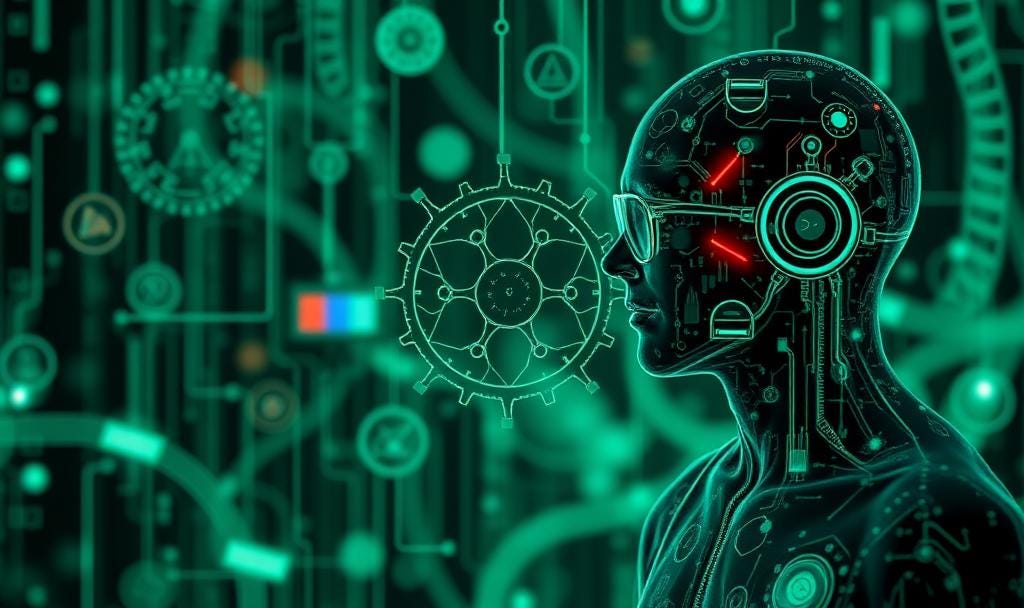
It’s not enough to cultivate healthy habits throughout your life—it’s about relentless self-optimization. Just quantify, control, dominate your body to beat life at its own game.
At the loud epicenter of the longevity movement is the biohacking crew. They have it all figured out. Everything sounds very science-y, blatantly vain, and extremely bro-tastic. Quantum meditation. Cellular renewal. Reprogram your skin! Reverse aging! Fix your baldness! You too can outwit, outspend, and supposedly… outlive?
These are a few of their hallmarks:
Armed with Information
Strap on a device and measure every possible biometric: REM sleep, grams of fiber, resting heart rate, skin temperature. Download the latest version of the app and check it constantly to see if you’re still functioning. But does more data, more information, and more tracking actually make us better?
Here’s the thing: cultivating our health requires self-awareness and self-regulation. We need to be regularly asking the existential and very practical questions: Am I okay? Am I on the right track? Am I a complete shitshow?
Wearables and biometrics give us something to buy and something to do to answer those questions. They aren’t inherently good or bad. But for me personally, meeting my basic needs for food, movement, and rest means spending less time on devices—and more time unplugging.
Control Freak
Devices like Whoop, a popular wrist wearable, promise exactly what their website claims: “Feel in control.” For the biohackers, the body can—and should—be quantified and controlled for maximum performance. Adhere to the intermittent fasting protocol (the bros don’t call them diets), “hit your macros” (that means eat the right ratio of protein, fats, and carbs), soak up the exact amount of red light therapy, then freeze your balls off in a cryo/hot/cold cycle. There’s always an exact plan to follow—and it’s often trademarked.
The promise is that we can have absolute control of our biology—and therefore avoid all those messy, unquantifiable feelings. But it’s not possible to outsmart or outspend the inevitable parts of being alive: suffering, aging, grief. And one of the actual joys of being alive is knowing how to find joy and connection through the hard times.
In reality we have some, but not total, agency over our health. Small, consistent, and flexible habits keep us humming along and usually outlast rigid, extreme regimens. And ultimately—regardless of how much overpriced vitamin A you ingest—you’re still mortal. Shit happens. Spoiler: eventually, we all have to give up control.
Stockpile Wellbeing
The optimized body is expensive. The impeccably sourced high-protein diet. The Erewhon smoothies. The White Lotus–style healing escapes. Perfecting the body demands a lot of resources.
As the current U.S. regime dismantles collective support structures, increasingly, wealth is health. The longevity dudes feed off our sense of scarcity and anxiety about the future—disguising greed and self-absorption as “self-care.” But let’s not pretend the obsession with personal wellness isn’t deeply privileged. There’s a big difference between investing in your well-being and fixating on it so intensely that you become an insufferable narcissist.
Yes, it often takes some financial resources to attend exercise classes, eat well, and find time to relax. But ideally, we take care of ourselves so we can get over ourselves.
Being healthy means we are more available to serve—to have the energy, clarity, and resilience to show up for our communities. What if our self-care made us more generous, more grounded, more useful to the collective—rather than just more self-absorbed and high maintenance?
Science, Schmience
The longevity industry feeds off anything remotely science-y in its quest for the next breakthrough biohack. But the actual research on personal care is pretty slow and predictable. Regular exercise is good. Going outside to play is good. Vegetables are better than McDonald’s. The deep basics of personal health don’t change much.
These guys appear obsessed with science to outsmart death—yet somehow missed the part in Bio 101 where everything is connected. If science tells us anything, it’s that we can’t survive alone. Well-being isn’t just about individual behavior—it’s about ecological viability.
I’m on board for living a long and healthy life—but I don’t quite understand relentless self-optimization during ecological collapse.
Yes, we can and should invest in personal health. But what if we framed wellness not as a personal escape plan—but as a way to build collective resilience? What if longevity wasn’t just about outliving, and more about how we show up now?
The real question isn’t just how long can the party last—but who do we want to be with while it does? You don’t have to be perfect—just healthy enough to show up. For the constant work. For the urgent healing. For each other. Let’s take care of ourselves so we can stay in the messy, beautiful business of collective and ecological repair.
I adore this!! Something I always talk about in Italy- very few people have wearables because our bodies TELL us when we haven't slept enough. Or moved enough. Or eaten right. It's outsourcing something that needs to be sourced from within. Love this piece and your writing!
Thanks for being a reader, Rachel!Yes—there’s so much wisdom that’s intuitive and always available to us, but we’ve become disconnected from it. Then we try to reconnect through digital or commercial means, often missing the point entirely.