
How to Get Strong
Five principles to reclaiming strength training from bro culture and body obsession

Following up on my strongman series, here’s my approach to strength training.
After 25 years of strength training, I familiar with the bravado of the weight room and have noticed bro wellness culture manspreading into our politics, psyches, and postures. Every day I’m doing my own resistance training to reclaim and democratize the tools of strength training.
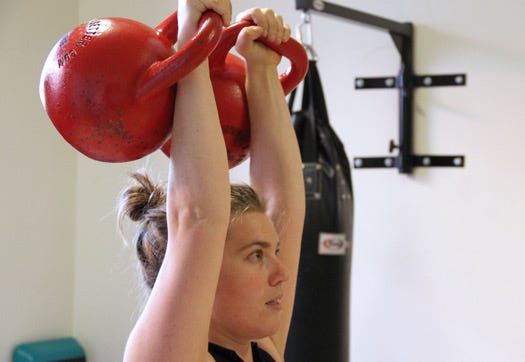
I’ve built a career out of understanding how we move and how we keep moving. I deal with achy, frazzled, and fatigued bodies every day. I respect the effort to carve out the time to make it to my online Movement Medicine classes, in-person yoga classes, or strength training classes, so I want that time to be effective. My classes present a range of body types, often in the same room: the grandmother concerned about bone density, the stressed lawyer parenting young kids, and the 40-something trail runner trying to stay in the game. My personal training clients usually are completely new to strength training, have complex injuries, or medical issues.
I’m always asking:
How do we get out of whack and how do we get ourselves back into whack?
How do we use movement as a potent, readily available medicine?
How do we get stronger and more resilient?
When fitness, especially strength training, is always sold as a way to achieve the perfect ripped, sculpted body, my job is to see beyond the facade and read movement patterns. Strength training is one of the most profound healing tools available. Regardless of age, ability, or body type, I’ve committed to making it as accessible, inclusive, and effective as possible.
This is my process:
Step One: Peel Off the Straitjacket of Stress
Often we need to do less before we can do more. To endure the workday, the caregiving, and the daily deluge of rage and grief, we armor up. But schlepping around protective and restrictive layers of stress gets heavy. Cortisol spikes, the jaw clenches, hip flexors lock up, and shoulders brace in hypervigilance. An “out of shape” body is often both wired and tired.
To have the excess energy to exercise, we need the privilege to stop working, the ability to say no to other obligations, and the bandwidth to redirect our metabolic resources. Often times the hardest part of a yoga class is just getting there.
To shed the exoskeleton of stress, I begin my classes with squirming: wiggling in a lunge, swinging the arms out, and rolling out the neck. Officially called “mobility” by fitness trainers, this is not just about physical aches and pains but the emotional safety for a body to express itself, to feel beneath the bracing, and to play again. In the wise words of Beyoncé, “release the wiggle.” We will never get stronger until we drop the emotional baggage.
Step Two: Train (In)Tension
We need to loosen up and let that shit go. We also need to tighten up and get shit done. The foundation of strength training is knowing where and how to tense up to be powerful levers. We need tension. It gets us out of bed in the morning and helps us carry the weight of our responsibilities. Existing in tension between what’s available and what’s possible is how we imagine and build something beyond ourselves.
When teaching strength techniques, I help students understand where there is too much tension, often in the front of the hips, and where there is not enough tension, like in a rounded upper back. Optimal tensegrity is a matter of knowing where we need mobility and where we need more stability. It sounds fancy, but it’s really just knowing which parts need more WD-40 and what needs duct tape.
Working and living in front of screens makes our minds mushy and our spines slouchy. It’s how many of us earn a paycheck, so our movement routines must realign and ready us for more variety and intensity. I’ve seen many folks walk into a weight room, start doing bicep curls with a hunched back, and then wonder why their shoulders get injured.
Too much seated screen time can make us more fragile, reactive, and hungry for a quick fix. More dynamic physical and emotional postures prevent injuries, allow us to lift heavier, lean into the creative stretch, and maybe even increase our ambiguity tolerance.
Step Three: Movements > Muscles
For years, bodybuilding defined weight training by dividing the body into individual muscle groups to flex, bulk up, tone, or sculpt. But bodybuilding is a subjective sport based on how the body looks, not on actual strength. Chopping ourselves into pieces to fix and fixate on doesn’t actually make us stronger and leaves too many folks out.
To build measurable strength, the body organizes into movement patterns, not muscles. Among strength and conditioning pros, the consensus is that there are around seven functional movement patterns: hinge, squat, push, pull, press, rotate, and carry. When I’m coaching strength training, the functional framework is scalable to various ability levels, addresses aging, prevents injury, and applies to everyday activities like getting off the toilet and putting your bags in the overhead bin on the plane. For example, the hip hinge is a deadlift, a movement I teach in yoga, and what we need to get out of a low chair without loudly grunting.
As a fitness trainer, I use these patterns as an assessment to build a program around what’s called progressive overload. If these movements are pain-free, we up the intensity by increasing the weights, duration, frequency, speed, or range of motion. Basically, do the hard, basic things over and over. My job is to keep it fun.
Step Four : Know the Difference Between Fitting In and Being Fit
The healthy human genome has a gloriously diverse expression. Even Olympic athletes of various sports have a broad range of body types. But for my entire lifetime, the fitness industry has sold us a commercialized, trending body type. From the aerobics craze and Special K diets to ab sculpting and detoxing, the industry constantly rebrands itself, always undermining our self-image.
Social media fueled that contagion, and now we see “strong, not skinny” trending on TikTok, targeting both men and women. Let’s be clear: the ideal is both very thin and heavily muscular, the kind of look celebrity culture holds up as aspirational. I would be more dismissive of the grotesque extreme of influencers, but my very average-sized friends are now popping GLP-1s.
As the patriarchal reins tighten, we should all stay busy chasing a look that absurdly performative, plastic, and pornographic. Guys are trying to look like UFC fighters, and grandmothers are trying to fit into beauty standards built for teenagers. Remember: you aren’t doing enough, you don’t have enough, and you aren’t enough. The ubiquitous ideal is supposed to keep you always reaching, with credit card in hand, for more.
Attempting to get washboard abs or stop the aging process will drain your bank account, fry your nervous system, blow out your knees, and turn you into an insufferable narcissist. If anything “works,” it will only be temporary. Maybe you won the genetic lottery and inherited the morphology that’s currently en vogue. Enjoy the party while it lasts. But if you are young, able-bodied, and athletic, don’t confuse that privilege for meritocracy.
Step Five: Exercise Your Agency
Beyond squats or push-ups, when we carve out the time to sort ourselves out and get into gear, what we are really doing is exercising our agency. Often I don’t really feel like doing anything, but I still drag myself into the gym, reminding myself that a “something is better than nothing” workout still counts.
The wellness hoopla constantly reminds us that we really should be doing more. More high intensity breathwork intervals, more myofascial optimization protocols, more protein-infused, adaptogenic hydration. The all-or-nothing downward spiral leaves us paralyzed and powerless.
The trick is finding the wiggle room under the overwhelm. The key to consistency is mostly sub-max lifts, greasing the groove of basic movements, and lots of mobility. This is not just a smarter way to train — it also coaxes me out of victim mode, effectively metabolizes emotion, and reminds me that I can deal with life.
If all this strength training business feels like too much, just going for a walk refreshes our perspective and renews our resolve.
The Strongest People
Athletes show us what’s possible with the human body, but the trailblazers who reshaped oppressive systems of power do the hardest resistance training. I doubt Harriet Tubman ever protein maxxed, but she did know how to survive in the forest, forage for edible and medical plants, and travel long distances on foot while freeing enslaved people. Susan B. Anthony never supplement stacked or PR’d her squat, but she did stick to a simple walking routine and summoned the core strength to fight for the 19th Amendment.
Does that mean all these modern tools of wellness and strength training are excessive? Maybe.
As I’ve asserted my entire career, it’s not the tools, it’s how we use them. Yoga could fixate on perfect poses. Strength training could dominate the body. Healthy eating could become policing every bite. Our bodies are either perpetually imperfect commodities always needing to be optimized, or they are perfect vessels to do meaningful work for as long as we can.
We can be disciplined without being blindly obedient. We can be healthy and never look pre-packaged. We can tend to our wounds without being self-absorbed. We can trust ourselves to eat well. We can marshal our muscles without punishing ourselves. Instead of floating off into a lavender-scented cloud of oblivion, or building a fortress of creatine & testosterone, our wellness routines can help us see through all the bullshit and stay focused on what matters.
Despite existing in an inherently extractive and quickly crumbling, economic system, our wellness practices remind us that we can regenerate our energy. Even when it all feels like too much, we have daily routines that remind us that a little something, done consistently, eventually makes a big difference. That’s how we get stronger.