

How much control over our wellbeing do we actually have? According to wellness messaging, quite a lot: Take control of your health! Invest in your wellness! We all have the same 24 hours in a day! Framed as empowerment, these messages make a great sales pitch but also reveal major blind spots. Years ago, I echoed a similar idea when I wrote, “Self-determination is health determination,” but lately I’ve changed my perspective.
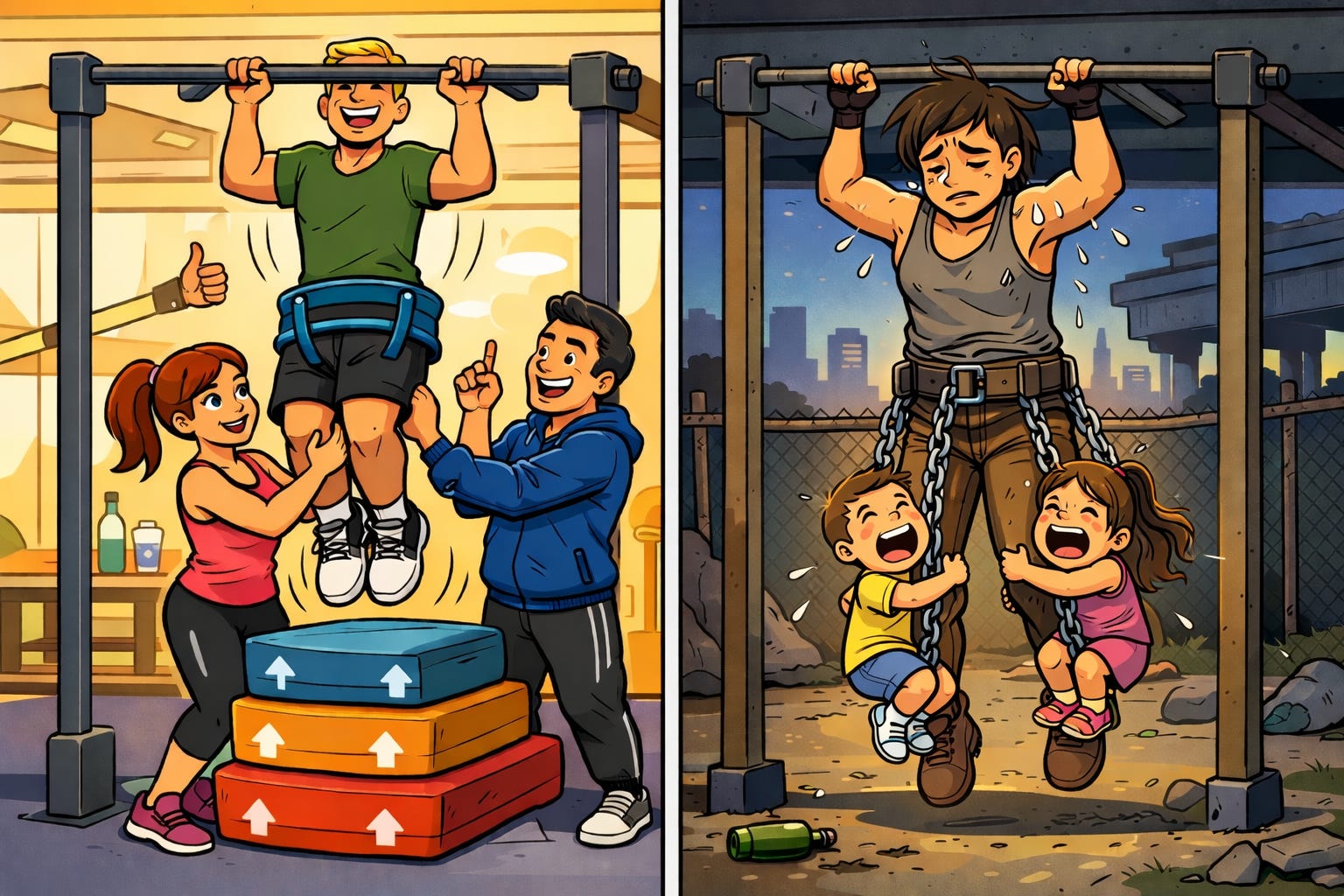
The message is clear: we can all make better choices to improve our health. Eat the right foods, crush your high-intensity intervals, hit your step count, listen to the right podcasts, down the supplements, get adequate sleep, and you’ll be perfectly fine. Just do all the right things, work hard, be disciplined. Sound familiar? These ideas reflect American meritocracy and rugged individualism, repackaged as self-care.
The belief that you, and you alone, are responsible for your health outcomes has a name: healthism. Coined by sociologist Robert Crawford in 1980, healthism describes the preoccupation with personal health as a moral obligation and personal achievement. It treats health as something we earn through good behavior, while quietly ignoring genetics, income, environment, discrimination, public policy, and sheer bad luck.
Healthism is so normalized that we barely notice how it shapes our response to current events. Watching ICE terrorize neighborhoods? Regulate your nervous system. Afraid of getting sick without adequate healthcare? Eat more antioxidants. Losing financial ground in a volatile economy? Go bulk up at the gym. When the world feels out of control, we’re sold the idea that tighter control over our bodies will save us.
This framework asks too much of individuals and far too little of systems. In practice, that shows up in a few predictable ways.
It’s too much to carry alone
Anyone else overwhelmed by the expectation to stay healthy, well-regulated, thin, and perpetually young? Doing all the right things can feel like a full-time job, one that easily costs hundreds of dollars a month. Health becomes a status marker, another place where we can never quite keep up, where not doing enough is treated as a personal flaw rather than a predictable outcome.
It rewards the performative and the narcissistic
Healthism slides easily into spectacle, especially on social media. Scroll through TikTok and you’ll find all-meat diets, crash cleanses dressed up as detoxing, and plenty of coffee enemas. The loudest, most extreme, and most self-absorbed voices end up defining what it means to “take control of your health.” And it’s not just the algorithm rewarding this behavior. Rather than holding press conferences or offering coherent public health guidance, we’ve ended up with our HHS secretary performing pull-ups in airports alongside wellness influencers for a photo op.
It conceals privilege as virtue
Having the time and energy to hit Pilates, shop for fresh ingredients, and chop vegetables for a wholesome dinner is very different from working late and relying on the drive-through to feed hungry kids. When self-care is framed as willpower, that difference disappears. Those with the resources to take care of themselves are praised as more disciplined, more intelligent, and more morally upstanding, while those with less bandwidth are cast as lazy, irresponsible, or uninformed.
It blames the victim
Healthism arrives as empowerment and quickly turns judgmental. We subsidize corn, flood the market with cheap ultra-processed foods, and then blame people for eating them and getting sick. Instead of changing policy to make fresh food accessible, responsibility is pushed downward. Struggling to stay well in an increasingly unaffordable society is treated as a personal failure rather than structural pressure. Healthism isn’t neutral advice. It’s gaslighting.
Most importantly, it’s absolute BS
Our health is shaped far more by where we’re born and the zip codes we live in than by what we put in our grocery carts. This is the core insight of determinism, a lens that reveals what healthism conceals. In Determined: A Science of Life Without Free Will, Robert Sapolsky argues that our lives are formed far more by biological and environmental forces than by individual choice. Genes, fetal environments, childhood stress, income, education, trauma, and social position all mold impulse control, health, and behavior long before “choice” ever enters the picture. As Sapolsky puts it, “we are nothing more or less than the cumulative biological and environmental luck, over which we had no control, that has brought us to any moment.”
No control? Ouch. At first, determinism feels like a real bummer. As someone who feels genuinely proud of my breakfast smoothies, exercise routines, and early bedtimes, it can sound like Sapolsky is dismissing my commitment to wellness. But read more closely and that’s not what he’s saying. He isn’t arguing that some people lack willpower or that others are blessed with a magical reserve of discipline. He’s pointing to the environments that shape impulse control and executive function. I’m not healthy simply because I work hard at it. I’m healthy because I have the capacity to take care of myself. And that capacity is shaped by support, stability, and resources long before it shows up as “good choices.”
Healthism is a great sales pitch. Determinism is the reality.
Our social, socioeconomic, genetic, and environmental conditions shape health far more than individual behavior ever could. Healthism is not merely an illusion of meritocracy; it is marketing, increasingly translated into policy. The MAHA emphasis on personal responsibility and empowerment eclipses a more basic truth: human beings require sustained, collective nurturing over a lifetime. While the wealthy purchase expansive support systems, poorer folks are inundated with cheap coping mechanisms and told to call it resilience. The result is a culture that insists we can optimize our way out of structural neglect, even as the conditions for health continue to erode.
As I was writing this, I came across the concept of Inheritocracy, developed by Eliza Filby, which makes a data-driven case against meritocracy by showing how inherited support, not effort alone, determines opportunity in housing, education, childcare, and affordability. She doesn’t explicitly address health, but the connection is obvious. Who gets praised for discipline, who is punished early for “poor impulse control,” and who was ever actually given the conditions to sustain themselves in the first place? Inherited genes, environments, and financial scaffolding shape who has the capacity to care for themselves at all.
This is where the wellness slogans finally collapse. Who actually gets control over their body and their time, and therefore their health? Who can make long-term investments instead of constant short-term tradeoffs? We do not all have the same 24 hours in a day when some people are insulated from economic pressure and others are working multiple jobs while caregiving and recovering from chronic stress. Framing health as personal control in a landscape this unequal is not empowerment. It’s propaganda.
I don't have TikTok, nor do I want it. But are you there, offering your truthful and thoughtful counter-approach to 'health' influencers?
Really insightful and important essay Sadie. Thank you for this.